View Glorious View
The act of a mindful reset walking in nature. And it's free.
Gia Marie Amella
There’s no time of year that I don’t head out for a walk in the countryside. My countryside cuts a pretty big swath across my area. It could be as simple as stepping outside my door and heading out to pathways that run along a stream that empties into the Arno river. Headed in the opposite direction, I can reach a small knoll that I can see from our upstairs windows. It’s thick with brush and wood, quite steep in some places as you climb higher. Stepping out from the foliage, there’s a large meadow and a cross that, at one time, you could see from below. It seems like many places in Italy have a cross placed in the surrounding hills that overlooks the city, perhaps suggesting a feeling of spiritual protection.
The day after most holidays, we head to the higher altitudes of the Pratomagno massif— it’s highest point is marked by a cross wrought in metal at just under 1600 meters, that's about 5250 feet, that we can see from our window on a clear day — that forms part of the Appenines that descends toward Arezzo before veering to the East toward the Casentino valley. Incidentally, one of my favorite areas to explore that receives little coverage in major travel rags. I always take this as an reluctance to entice editors to cover some of Tuscany’s less traversed areas that may not invite more clicks.
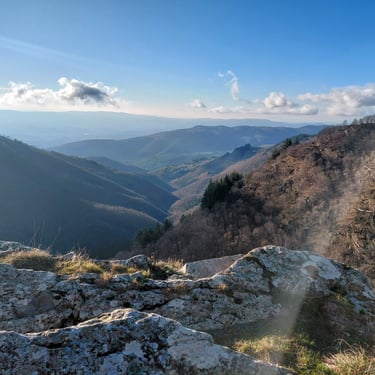
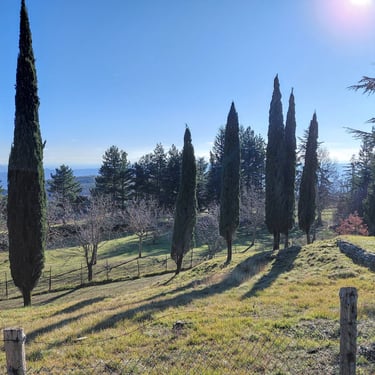
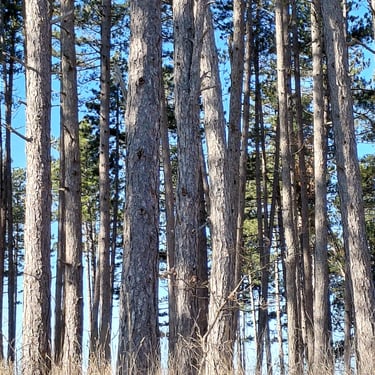
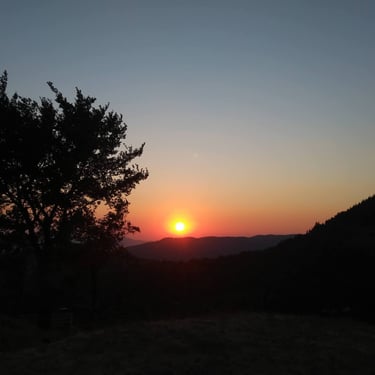
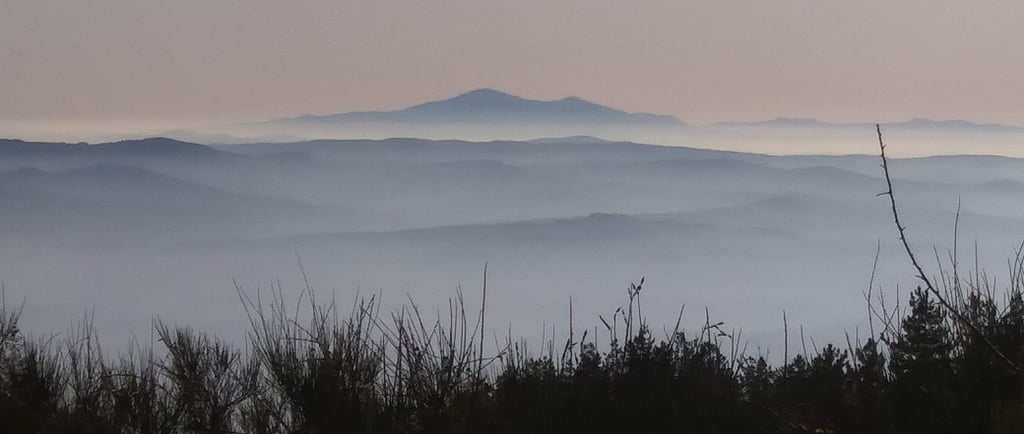
One of the places we’ve been walking for years is located roughly between the mountain villages of Chiassia and Anciolina, both with stunning views overlooking the Valdarno where we live, particularly Anciolina where on a clear day you can see the Duomo’s bell tower in the charming city of Arezzo, incidentally one of the original Etruscan cities that amassed its fortune from gold. Generally, we pick up a schiacciata with mortadella at a quaint sandwich shop, nothing fancy, just real, run by a local family in Chiassaia that I managed to make mention of in a piece I wrote for National Geographic focusing on experiences to be had in Tuscany (some favorites, some standard). This walk is all about the sweeping, wide-open views when my body screams for sun and a serious replenishing of Vitamin D when it’s cold out. The walk’s takes us along the quintessential winding road through the variegated countryside thick with pine, oak, cypress trees, scopa (broom), heather, and ginestra (in full bloom, its yellow flowers emit a glorious profume that wafts across the countryside, even reaching the valley where I live on a warm day. The position is so perfectly situated that on a cloudless day you can see the peaks of Mount Amiata, an extinct volcano located about an hour’s drive south of Montalcino. I’ve taken countless photos on our walks here. One of my favorites, pictured above, captures the mountain's contours at dusk in winter as the fog settles in the valley.
I love foraging here, too. I generally have a knapsack for snacks and water with room enough to fill up with pinecones and acorns, stones and pebbles, twigs and small branches. I always have a pair of clippers reader to snip off a larger branch to stick in a vase at home. On two occasions, my spouse and I were walking and ran into an older woman, probably in her 70s or 80s, throwing armfuls of long scopa twigs into the back of her pickup out of which she constructed brooms. Bundled together, the broom’s tangle of close-set branches perfect for sweeping pavements and surfaces. If you’ve ever been inside an old country house, it’s likely you’ve seen one propped up in the barnyard or next to the fireplace for sweeping up charred embers.
It’s a contemplative place where I can stop at leisure to pick up a branch, or a leaf and really see it. I’ll often find a rock that doubles as a seat and take in the view for a while, completely unhurried. These few hours of respite let me relax into myself. And when I’m finally back home in the valley, the feeling of being totally absorbed by nature takes me through the day. Then I go about my daily tasks with a clearer, lighter head.